Costs & choosing
How much do drone services cost in the UK?
Published price examples, the reasons quotes differ and a practical way to compare the full cost of a drone assignment.


A practical customer checklist for checking the operator, insurance and proposed flight, without getting lost in outdated licence terminology.
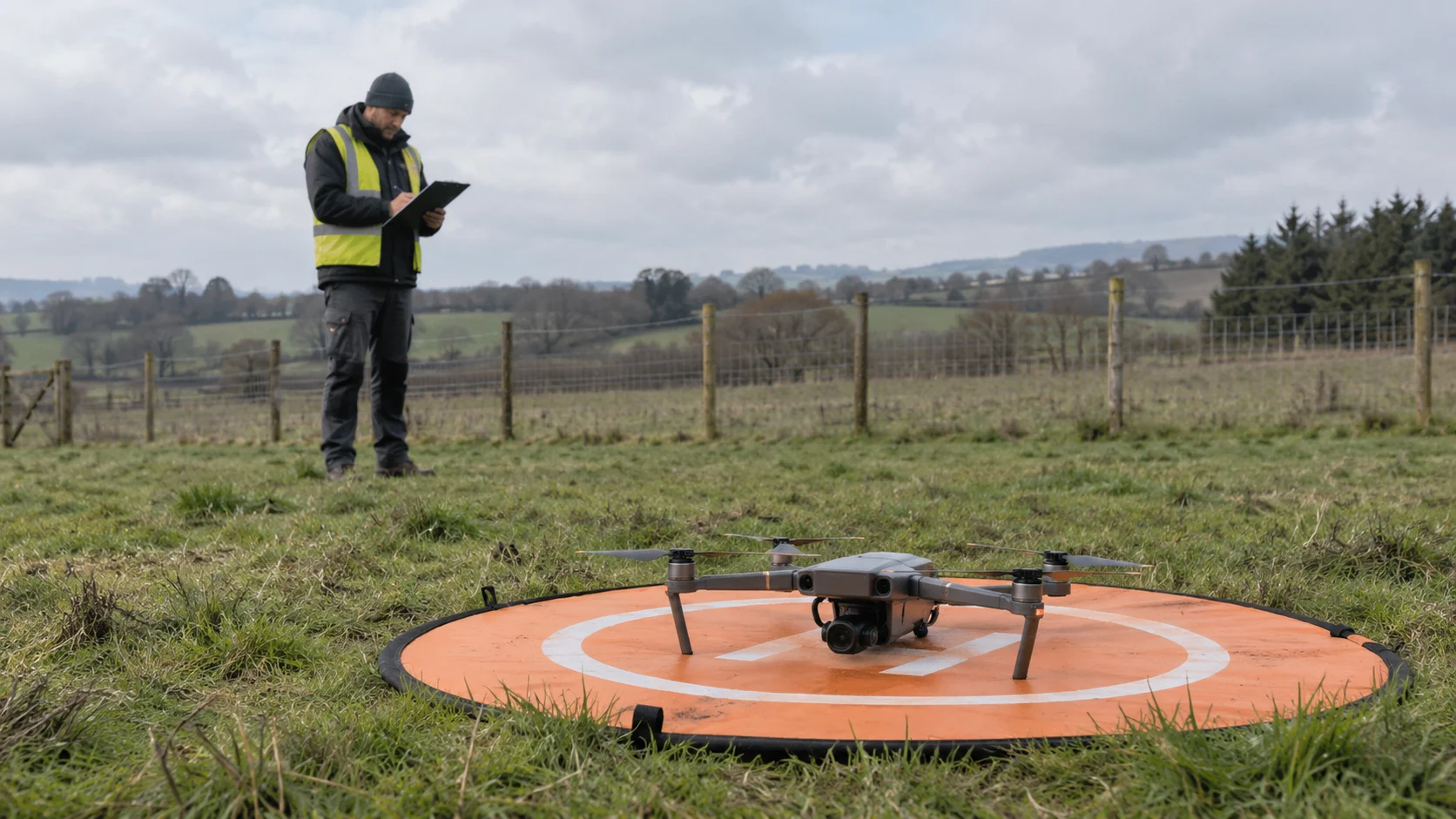
Hiring a drone pilot should start with a simple question: can this provider safely and lawfully deliver the images or measurements you need at this particular location? A badge on a website cannot answer that. Send the full address, site boundary, intended output and any known access constraints before accepting a quote.
The CAA regulates flights according to risk. Paid work can fall within the Open category; being a commercial service does not automatically mean that a Specific category authorisation is necessary. The old Permission for Commercial Operations, or PfCO, was withdrawn when the framework changed at the end of 2020. Treat an unexplained promise of a 'commercial drone licence' as a reason to ask a better question, rather than proof that the provider is unsuitable.
These are different checks. An Operator ID concerns the person or organisation managing the aircraft. Pilot competence concerns the individual flying it. An Operational Authorisation is required for Specific category operations and sets limits on those operations; it is not unrestricted permission to fly anywhere.
The CAA's current 2026 guidance requires a Flyer ID for aircraft weighing 100g or more. An Operator ID is required at 250g or more, or from 100g where a camera is fitted. Class marks and transitional provisions also affect permitted operations. That is why an older statement that every drone below 250g is exempt is unreliable.
Our practical recommendation is to ask the provider to explain which category covers your job, what competence that requires and who will operate the aircraft. You do not need to become an aviation examiner. You do need an answer that relates to your site, rather than a bundle of certificates with no explanation.
The CAA requires third-party insurance for work and other non-recreational flying. Ask for evidence that covers the proposed activity and booking date. A company logo on a certificate is less useful than confirming that it relates to the operator actually attending.
If you book through a network, establish who accepts your instruction, who supplies the pilot and who handles a complaint or reshoot. This is a purchasing recommendation, not a claim that networks are inherently better or worse than direct operators. A clear chain of responsibility helps you resolve problems without being passed between businesses.
The operator must assess applicable airspace restrictions; locations around aerodromes can need additional permission. Your permission to use a garden or car park does not replace aviation requirements. Equally, a flight restriction does not always make a job impossible: it may change the process, lead time or feasible approach.
Give the provider useful information: public footpaths, busy entrances, scheduled deliveries, cranes, overhead cables and sensitive neighbouring premises. These are prompts for the operator's assessment, not instructions for you to design the flight. In a hypothetical warehouse inspection, a quiet Sunday visit might be more workable than a weekday visit during loading operations. Ask for the reasoning and any resulting price difference.
Agree that the pilot can delay, modify or stop the operation if conditions change. A provider promising to fly regardless of weather or public activity is not offering certainty. It is avoiding the difficult part of planning. Judge the service on a realistic plan, useful evidence and clear communication.
This guide is a customer purchasing aid, checked against the official sources below on 9 October 2026. Operational requirements can change, so the provider should verify the rules applying to the actual flight date.
No. Requirements depend on the aircraft and operation. Ask how the proposed flight fits the current CAA framework and what competence or authorisation it requires.
No. Site access and applicable airspace permissions are separate matters. Ask the operator to assess both before confirming the visit.
Find providers advertising the relevant service and compare the proposed deliverables before booking.
Published price examples, the reasons quotes differ and a practical way to compare the full cost of a drone assignment.
Understand what a thermal image measures, what it cannot prove and how to commission useful analysis rather than a colourful picture.
A practical briefing guide for estate agents, property owners and marketing teams commissioning aerial photographs or video.