Costs & choosing
How much do drone services cost in the UK?
Published price examples, the reasons quotes differ and a practical way to compare the full cost of a drone assignment.


Understand what a thermal image measures, what it cannot prove and how to commission useful analysis rather than a colourful picture.
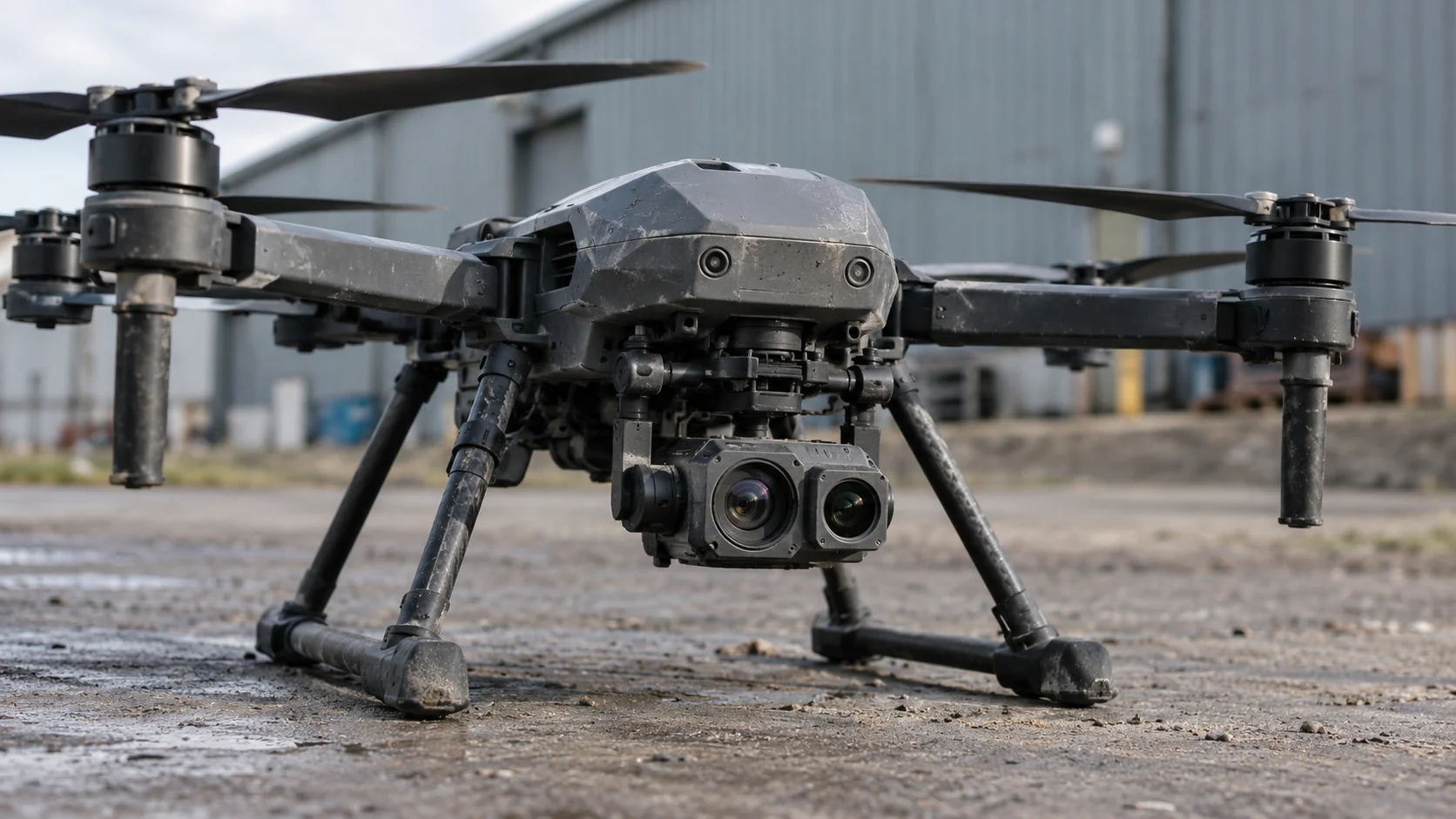
A thermal inspection can help investigate an asset by showing temperature patterns that are not apparent in an ordinary photograph. The useful question is not whether the image looks dramatic. It is whether the pattern helps answer a defined question about a roof, building or installation.
FLIR explains that thermal cameras do not see through an ordinary wall: they register its surface. Heat from something behind it can sometimes affect that surface, but the resulting image is an indirect observation. Its guidance also describes how ordinary glass and shiny metal can reflect infrared radiation. Treat these as reasons for careful interpretation, not as a reason to assume thermal work is useless.
Suppose, in a hypothetical building inspection, one part of a roof appears warmer than the surrounding area. The useful report should explain where that area is, the circumstances of capture and possible interpretations. It should also distinguish observations from conclusions and set out what could confirm the explanation.
Do not assume a bright patch proves water ingress, failed insulation or a dangerous component. Ask the specialist what other explanations were considered and whether a physical inspection, electrical test or another measurement is needed. That makes the thermal work part of an investigation rather than a substitute for reasoning.
Being able to see a small feature on a screen does not establish that its temperature can be measured accurately. FLIR’s distance guidance explains the importance of sensor resolution, field of view and the number of pixels covering the target. Digital enlargement does not create extra measurement detail.
The purchasing implication is straightforward: describe the smallest feature that matters and ask the provider to explain its capture method. A quotation that lists only a drone model tells you less than one that explains the target, required detail, practical viewing distance and reporting limits. The appropriate setup depends on the asset and purpose.
Ask who will interpret the images and what relevant experience they have with your asset type. Agree which conditions need to be present before attending, and who decides whether those conditions are suitable. If the main purpose is analysis, do not prioritise the earliest appointment over a usable dataset.
A practical brief should identify the asset, your concern, available maintenance history and the decision you expect to make. Ask for paired visual and thermal images, location references, a description of capture conditions and a clear explanation of limitations. If you need temperature data for later analysis, discuss the data format before assuming that a standard image file is sufficient.
Use sample reports to compare how providers communicate uncertainty. Can a facilities manager locate the observation? Can another specialist understand the basis of a finding? Does the report separate immediate observations from recommended next steps? These are more useful purchasing questions than whether the colour palette looks impressive.
For a repeat inspection programme, ask how the provider will keep asset identifiers, viewpoints and records consistent. This is our practical recommendation for making successive visits easier to interpret; it is not a promise that every temperature difference between visits represents a change in condition.
It does not provide an X-ray view. Thermal observations are of visible surfaces and require interpretation in the context of the building and capture conditions.
Not always. Ask what the observation supports, what remains uncertain and what further investigation could confirm the cause.
Find providers advertising the relevant service and compare the proposed deliverables before booking.
Published price examples, the reasons quotes differ and a practical way to compare the full cost of a drone assignment.
Compare the buying process, accountability and practical trade-offs of a managed network, an operator directory and a direct supplier.
A practical customer checklist for checking the operator, insurance and proposed flight, without getting lost in outdated licence terminology.