Costs & choosing
How much do drone services cost in the UK?
Published price examples, the reasons quotes differ and a practical way to compare the full cost of a drone assignment.


Why aircraft capability, site conditions and the quality of the result matter more than a single wind-speed figure.
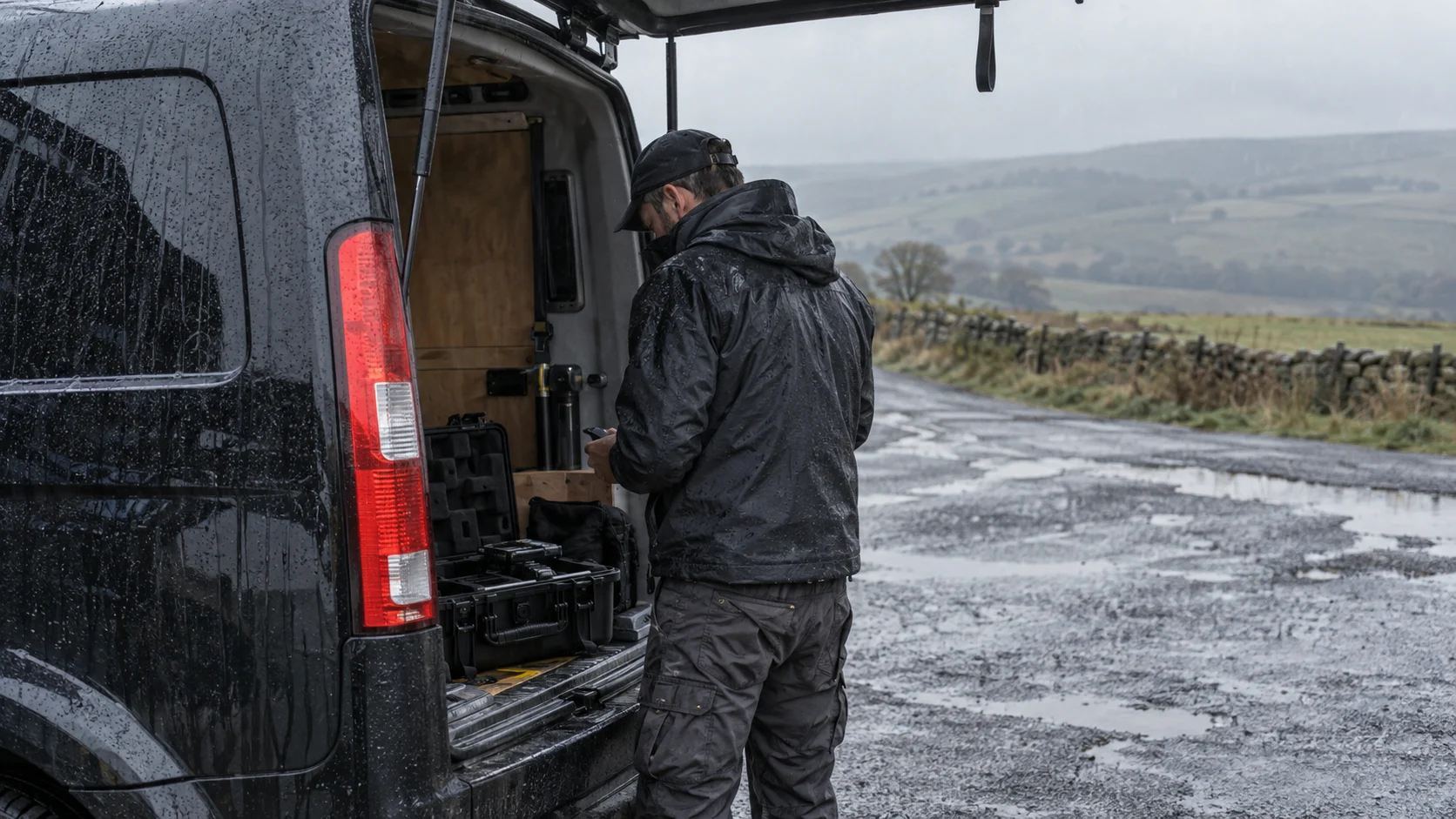
Some drones can operate in conditions that would rule out others. A customer cannot reliably decide whether a visit should go ahead by looking at the forecast alone. The provider needs to consider the specific aircraft, payload, manufacturer guidance, location and proposed task. The remote pilot makes the operational decision on the day.
DJI's Mini 4 Pro FAQ says the aircraft is not waterproof and should be returned and landed if rain starts. By contrast, DJI lists an IP55 rating for the Matrice 350 RTK, subject to limitations and deterioration through wear. These examples demonstrate why 'drones can fly in rain' and 'drones cannot fly in rain' are both too broad. Neither example is a recommendation to operate in a particular set of conditions.
Manufacturers publish different wind-resistance figures. For example, DJI lists 10.7 metres per second for the Mini 4 Pro and 12 metres per second for the Matrice 350 RTK. These are model specifications, not a universal customer threshold or a promise that your job is suitable at those speeds.
The CAA highlights that wind at height can differ from conditions on the ground, and that difficult weather affects power requirements. It also identifies visibility, rain and cold as flight-planning concerns. Our purchasing advice is therefore to ask how the provider evaluates the whole site rather than negotiate over one forecast number.
In a hypothetical roof job, the customer may be standing in a sheltered garden while the aircraft would need to work above an exposed ridge. A delay can be reasonable even when the garden feels calm. The useful question is what alternative date, position or capture method would still meet the brief.
There are two separate decisions: whether the operation is safe, and whether it can deliver the required result. A provider should be able to explain both. A property marketing film needs suitable presentation; a mapping project needs a dataset that can be processed reliably; an inspection needs the relevant details to be visible.
Pix4D's capture guidance explains that lighting, precipitation and atmospheric clarity can affect photogrammetry, and recommends soft, consistent light. That does not mean every job needs sunshine. For some mapping work, even cloud cover can be useful. The exact requirement depends on the task.
Our recommendation is to describe acceptance in terms of results: which roof elements need to be distinguishable, which site area needs complete coverage or what visual style the finished film needs. This gives the provider a reasoned basis for deciding whether to proceed, instead of simply recording that a drone took off.
A fixed date is convenient, but a realistic weather arrangement is often more valuable. Ask when the provider normally confirms attendance, who contacts whom and what happens if conditions change after arrival. Read whether a rearrangement affects travel charges, deposits or delivery dates; terms vary by supplier.
For deadline-driven work, our practical recommendation is to book a primary window and identify a fallback. A marketing launch may allow earlier capture. A construction record may need a narrower slot because the site changes daily. Tell the supplier which deadline is genuinely fixed and which details are flexible.
Contact the provider and follow the agreed confirmation process. Forecast timing, aircraft capability and the job itself all matter; do not assume that any forecast rain means cancellation.
No. Equipment may widen the workable conditions, but manufacturer limits, flight safety and the required quality still apply.
Find providers advertising the relevant service and compare the proposed deliverables before booking.
Published price examples, the reasons quotes differ and a practical way to compare the full cost of a drone assignment.
Understand what a thermal image measures, what it cannot prove and how to commission useful analysis rather than a colourful picture.
A practical briefing guide for estate agents, property owners and marketing teams commissioning aerial photographs or video.